
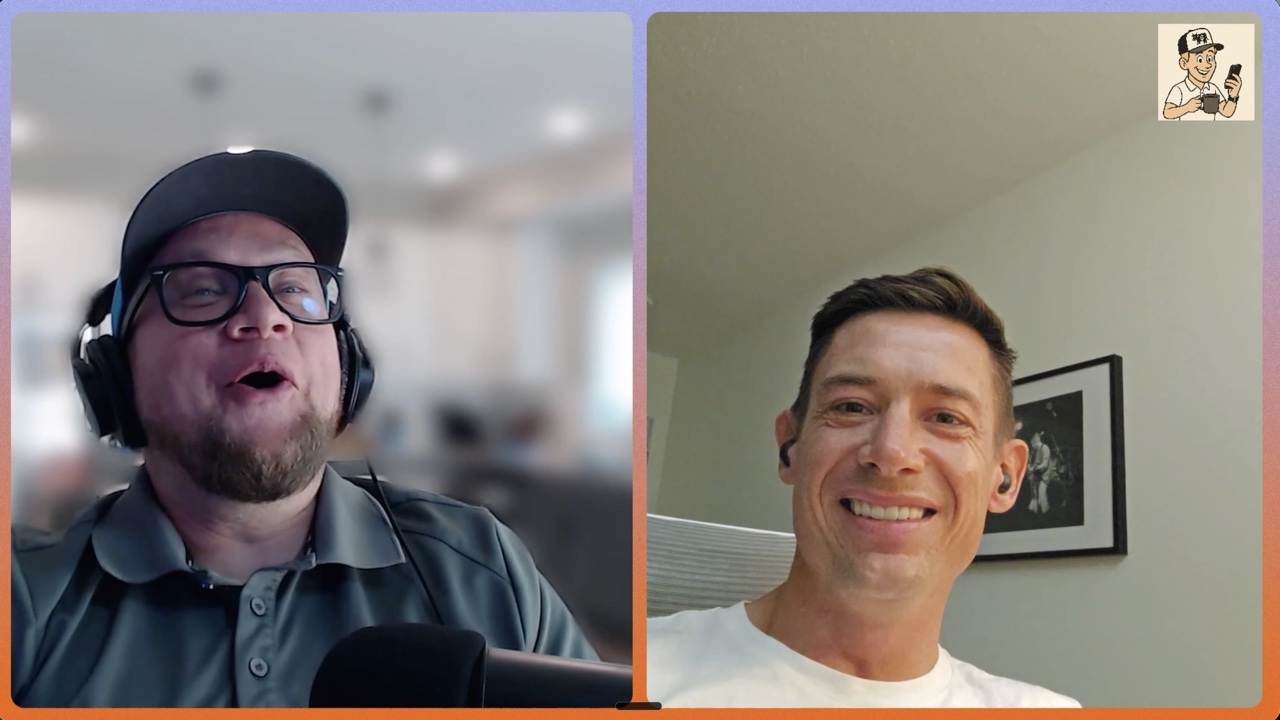
Jon "Wayne" Weight is a roofer and home-exterior salesman who came into the trade the long way, out of the music world. He picked up the "John Wayne" name as a twelve-year-old in a small North Dakota town, spent years in a band, and still lives part of the year in Thailand. What comes through in this one is that he treats roofing like a people business first and a sales job second.
The heart of the episode is honesty. Jon tells the story of a roof and siding job that went sideways: a price got misquoted, material costs jumped over the winter, and an insurance supplement made the homeowner think he'd been handed free money. It got ugly, a crew got pulled off the job, and there was an hour-long call with the adjuster. Then the homeowner walked around the side of the house, gave Jon a hug, apologized, and paid in full before the work was even done. Second best paying job he's ever had. His takeaway was simple: that should have been a phone call, not a text.
We also get into his read on the business. A good company isn't all emotion and it isn't all profit. It exists to serve people, but it can't serve anyone if it doesn't make money. Walking away from a bad-fit job, in his framing, isn't ego. It's the humility to say a different contractor might be a better fit. And he closes with a straight take on the roofing "gold rush" a lot of people still believe in: insurance used to pay $700-plus a square, standard, and now you supplement nearly every claim to make it work. He won't file a claim on a roof that isn't actually damaged.
Watch: YouTube Listen: Apple Podcasts · Spotify
Chapters
- 00:00 - Introduction and Jon's background
- 00:23 - The story behind the "John Wayne" nickname
- 01:05 - Transition from music to roofing
- 02:25 - Getting into the trades and initial experiences
- 03:11 - Building relationships with homeowners
- 04:37 - Project management and customer interaction
- 05:56 - A memorable roofing crisis story
- 08:22 - Dealing with insurance and cost surprises
- 10:11 - The homeowner's reaction and resolution
- 12:30 - Communication: texts vs calls
- 13:56 - What makes Jon a good contractor
- 16:03 - Closing deals with integrity
- 17:55 - Balancing profit and service
- 19:19 - Walking away from bad jobs
- 20:48 - Advice for the next generation in trades
- 24:24 - The changing insurance landscape
- 27:18 - What homeowners should know about insurance and roofing
- 28:31 - Final thoughts and life outside of work
The big takeaways
- Over-communicate, and know when to pick up the phone. The whole crisis story came down to one hard update sent as a text instead of a call. Read your customer, and match the channel to the weight of the message.
- A good business walks a middle ground. Not all emotion, not all profit. It serves people, but it can't serve anyone if it doesn't make money.
- Walking away from a bad-fit job is service, not ego. Having the experience to know when a project works for both sides, and the humility to hand it off, protects the customer and the business.
- The roofing gold rush is over. Insurance used to pay $700-plus a square as a standard. Now you supplement nearly every claim, and homeowners should plan for real out-of-pocket cost.
- Don't file a claim on a roof that isn't damaged. Jon draws a hard line on this. It builds trust, respects the homeowner's time, and keeps you off the shady-contractor list.
- Care deeply and be detail-oriented. When asked what makes him good, that was the whole answer. The relationships outlast the projects.
Full Transcript
Lightly cleaned for readability. Speaker names and a couple of mild words tidied; nothing of substance changed.
Reasonable Tech Dad (00:00) Welcome, ladies and gentlemen, to another episode of the Reasonable Contractor Podcast. I am your host, Ryan Templin, the Reasonable Tech Dad. And today we have a friend of mine who's done some work on some roofs, a freelance roofer. He goes by John Wayne. Technically his name's John Weight, but I think John Wayne is pretty cool. Some of the folks listening might be a little young for John Wayne references, but the people that know, know. John Wayne is about as cool a label as you can get, dude. Why don't you tell us your story, John? How'd you get started? And start with that: how'd the John Wayne thing come up? How'd you get that label?
Jon Weight (00:36) Yeah, thanks for having me. So I was probably twelve years old in a small town in North Dakota, and I'd introduce my name in class, probably middle school, and people were like, "John Wait." I'd say, "No, John Wayne." And since high school people just started calling me John Wayne, and it stuck. But for professional business reasons I like to have my real name listed too. This one homeowner I was working with on a roof in Saint Paul knew me from music, and everyone from music only knew me as John Wayne. Then she found out my real last name was Weight, and she was like, "You lied to me. I can't work with you." So since then I try to put my real name on my email signature and all that too.
Reasonable Tech Dad (01:45) I've noticed that, dude. So how'd the roofing thing start? Were you always a roof guy? How'd you crack into the trades?
Jon Weight (01:54) A friend of mine worked for a company in Wisconsin, and I did my first year and a half or so with those guys. It was in conjunction with music, which to some degree it still is, but now I'm more focused on roofing and home exterior stuff. I learned a lot, but I didn't ever expect to like this kind of work. I remember seeing friends doing this work back around 2010. This guy Mike I knew was all stressed out one day and said a partner of his stole four hundred thousand dollars from him.
Reasonable Tech Dad (02:43) Holy crap.
Jon Weight (02:45) Yeah, big money. And that was 2010. What's four hundred thousand adjusted for inflation now? But even beyond that, I just wasn't interested in selling home exterior stuff. Now, beyond the money being decent, I love it. Truly. I like meeting with homeowners and building those relationships. A lot of the people I've worked with I still talk to. I'll just shoot a text over. I just realized that I like people.
Reasonable Tech Dad (03:22) Same. I have a two-year electrical degree and did industrial automation on the floor at a big plant for three years after school. I've been a tech guy too, took a lot of coding ventures, because I love tech stuff. I'm a systems guy. But being out on the job site all day in the elements was never for me. I'd get grumpy and my brain would drift. It sounds like you're more on the sales side. Have you always been more sales, or have you spent time swinging hammers?
Jon Weight (04:01) Yeah, I like the not-swinging-hammers part. Project manager is the loose title for most people in my position. The companies I work for do most of the material ordering, and there's a bigger level of project management than what I'm doing, but I've ordered some roofs and I understand that part. For a really big job I like to have a helping hand.
Reasonable Tech Dad (04:37) I brought that up because I've walked a similar line. Project management has been a nice balance for me, staying connected to those guys but really, like you said, connecting with people. When I go to a job and somebody has a vision for their house, or with roofs there's a lot of panic, people are frustrated or scared because something bad is happening. Being able to be of service and help them find something that suits their budget in a time of crisis, there's a lot of purpose in that. So along those lines, man, I know you've got some stories. Any crazy ones from the roofing days?
Jon Weight (05:28) There's never been a crane drop through a roof or anything that bad, I've only seen videos of that. But there's a story from a couple years back. I was pretty inexperienced. The owner of the company I was working for had quoted a unified steel stone-coated shingle for this house. It wasn't huge, but the price per square wasn't estimated properly. We signed a contract, got a deposit, and it got pushed to the next spring because it was late in the fall. By then material prices had gone up, and we realized the profit margin was going to be extremely low, almost non-existent.
Reasonable Tech Dad (06:44) Right, underwater sometimes.
Jon Weight (06:45) My inexperience was part of it, and the owner took responsibility for not catching that material prices had gone up, probably even misquoting it at the start. So we did a standard thing and supplemented with his insurance. I sent the homeowner, who I had a good relationship with, a text saying we'd requested a supplement asking for more money. He gave me a thumbs up. So it was communicated, but it probably should have been a phone call. We started the project and he called me and said, "I love you, man." I said, "Really? Why?" He said, "Insurance just sent me this other huge check." Meaning he thought he got to keep all that money. So I said, "Hey, let me call you right back."
Reasonable Tech Dad (07:58) Oh no.
Jon Weight (07:59) I got the sales manager on the phone with him, which I shouldn't have, because he's a bulldog. He's on the phone saying, "No man, that's our money," but we had a contract that said it. And the homeowner's like, "I'm not paying more just because you guys got more money from my insurance." The sales manager called our siding guy, who was there because it was a roofing and siding job, and told him to leave the job site. It got elevated unnecessarily. I take responsibility for the communication on the front end, but the homeowner was so upset.
Reasonable Tech Dad (08:57) People get mad and they escalate.
Jon Weight (08:59) So I said, "Let's get on the phone with your insurance, they'll clarify why." We had an hour call with the adjuster. It was ugly. Even though the adjuster said, "Your contractor sent an exact estimate, this is all legit, we approved it, this money is owed to them," the homeowner wouldn't answer my calls after that. We were nearing the end of the project, put the guys back on, and decided to go through with it come what may. I went to his house and knocked. The siding guys were finishing. He didn't answer, even though his car was home. I said, "Shoot." Then I'm standing outside talking to our siding guy, and he walks around the side of the house and gives me a big hug. He says, "I'm sorry, man." He paid me in full even before the job was done. It ended up being the second best-paying job I've ever had.
Reasonable Tech Dad (10:22) Very nice. And that's when you have good intentions even through mistakes. We talk about that a lot here. Any construction project is not what people think it is. The amount of money they're committing is, for most people, the biggest purchase they'll make, and a lot of emotions get involved when they start to understand what we already know going in: things change, you run into surprises, significant cost swings, thousands of dollars. Just to clarify that story for people: when you signed the contract, that amount was submitted to insurance and approved. Then when the material cost came up and you submitted extra, the insurance company cut a check for that exact increase, and that's the check he got. He thought that money was extra and didn't realize it was going to you guys.
Jon Weight (11:17) Yeah, but it was way more. Insurance would never pay us directly, I've never seen that happen. He thought it was his money. And I'd said sorry before that too, that I shouldn't have texted him about it, I should have called and explained it. That would have cleared it up. It was a lesson for sure. We didn't do anything wrong legally, it was just my communication that should have been more than a text.
Reasonable Tech Dad (12:04) You touch on an interesting point, text versus call. As the technology's gotten more common, you have to read your customers. Some people like to be texted over a phone call, and vice versa. Even if somebody prefers text, there are certain conversations where you should get on the phone. For a lot of people who do our kind of work that's uncomfortable, but you've got to consider it. Some people say just text everything, some say just call every time, but people are working, these jobs run weeks and months, and it's business hours. Be cognizant of the type of communication based on what you're trying to say, and consider whether a text is adequate or a phone call is necessary. Since this is for contractors, why don't you talk about what makes you good? I think timeliness, getting them the quote, and intensity around timelines makes people feel comfortable. Being organized, using calendars, getting people answers so they're not left waiting. What else do you think makes you good?
Jon Weight (13:43) Just that I care deeply. I'm detail-oriented. I've learned a lot, having less autonomy earlier on and more now, so I've been able to learn the whole process. But mainly it's that I care deeply, that I'll do whatever I can, and communication on the front end. I'd rather walk away from a job and communicate clearly than agree to something and have problems. In the end it is about profit. A low-profit job I'm happy to walk away from. I've got another story. Last summer there was a storm, and I met with this homeowner. Most of my work is through referrals, but I'd knocked on his door and had good rapport. When it came time for a deposit and picking colors, he kept trying to add things onto the job before he'd agree to it, and he balked at the fifty percent down payment, said he was tight on money. I really felt he might not pay us in the end.
Reasonable Tech Dad (15:14) Yeah.
Jon Weight (15:14) So I said, "Thanks man, I appreciate your time. I think this might be better suited for a different contractor." He was so upset. But I didn't say anything I regret, I communicated clearly, and my sales manager was really happy I walked away from it. Communication is the biggest one, like that previous story. Over-communicating gives people a lot of comfort.
Reasonable Tech Dad (15:50) Agreed. You touch on another good point. So many people say you need to close the deal, there's no reason it shouldn't close. But how good is the deal if it leads to a job that changes scope or someone's upset? The more I do it, the more important choosing the people you work with becomes. When I asked what makes you good, you said you care a lot. People try to say you have to be one way or the other, that business can't be about emotions, or that it's all about profit. What you're describing is the balance. A business should exist to serve people and its community. But a business can't function without profit and revenue. It's not black and white. It can't be all sales, and it can't be all accommodating everybody and "the customer's always right." There's a middle ground. Diagnosing people who might not be in a place to afford the projects you provide, and being able to walk away, is a really good skill. It's not easy, feelings get hurt and the business would rather have the job, but if it doesn't work it's bad for both parties.
Jon Weight (17:24) Absolutely, a hundred percent. I just care deeply, and I like people. I still text with people from years ago because I'm friends with them.
Reasonable Tech Dad (17:42) The relationships are what make the business good long term and make you feel good about what you're doing, both with people in the business and the clients. So what else is difficult? We've touched on communication and scope clarity, and material changes. Are there other areas that are challenging about roof or exterior sales that could help people, or have we touched on the main ones?
Jon Weight (18:26) Those are the ones that come to mind immediately. I'm sure there's plenty of things, and people watching might wonder why I didn't mention this or that, but I haven't had a lot of problems. Walking away from a job just feels good if you know it's not the right fit. It truly does. That's something I learned from a guy named Max I worked with, who's quick to walk away from jobs.
Reasonable Tech Dad (19:05) Sorry, go ahead. I was going to say, some people make it sound like ego, like you think you're too good to do everybody's job because they don't have money. That's not it at all. What feels good about it is that you have enough experience to know when a project is going to benefit both parties, rather than putting the business or the customer in a spot that creates dynamics that upset people. It's the opposite. It's trying to be of service and identifying situations that aren't going to help people.
Jon Weight (19:51) I don't think it's too much ego, I think it's being realistic. It takes less ego, in a way. If you think a job's profit isn't right, or the customer's going to be difficult and cause problems later, walking away is actually more humble. Saying, "I don't think this is a good fit, maybe a different contractor would be better," there's real humility in that, and I like that.
Reasonable Tech Dad (20:30) That's a way better framing. Now that I hear you say it, that's a way better framing.
Jon Weight (20:34) I don't know if it's better, that's just my take.
Reasonable Tech Dad (20:38) It's good, man. I'm open-minded, I like being corrected. Let's talk about the next generation in the trades. Talk to the kids, teens or early twenties, maybe scared of AI, we can get to that too. Let's talk about why young people should consider getting into the contracting world.
Jon Weight (21:05) Hm. They should. Here's the reason. There's this 2010-to-2018 idea still alive that this is a gold rush, that it's easy money, insurance will approve everything, go storm chasing. Not to say storm chasing is the only aspect of home exterior sales, I've done a fair amount of retail, but I'd say that gold rush is dead. I started in the spring of 2023, so I haven't been in the industry that long. From talking with other people, insurance used to pay $700-plus a square on roofing, if not more, pretty much standard. Now you pretty much have to supplement every roofing claim, because it's like $550 a square. You can still make money on that, but it's considerably different than $700-plus. And for a re-deck, even code-related, the amount they pay seems really low. So it's hard work. If you think you'll get on a roof with mild or moderate hail or wind damage and it's easy, there's a high likelihood they won't pay for it, and if they do, they'll skimp and you'll have to supplement. If your company does the supplementing, great, but if you have to do it yourself, you've got to know what you're doing. There's a lot of moving pieces from a homeowner agreeing to an inspection, to filing a claim, to actually making it profitable. Hard work is the real answer.
Reasonable Tech Dad (23:44) That's really well said, super fair, and interesting in contrast to what a lot of people say. A lot of guys say the trades are wide open, we need to get into it. But where you're coming from, correct me if I'm wrong, is that exteriors specifically had a gold-rush time. And because it went on so long, a lot of homeowners have that framing: my neighbor got a new roof or siding and insurance paid for it. Insurance companies aren't playing that anymore, and the changes built around it are very tight. So what happens now if a homeowner needs a new roof and insurance isn't the only answer? Are people having to plan to pay out of pocket?
Jon Weight (24:46) Yeah, a lot of out-of-pocket. Materials prices have gone up, so gaining retail sales skills is important. But the other thing is, I don't want to file a claim on a roof that's not very damaged. I want to give people the correct information. That builds trust. Not just, "I got on the roof, so now we file a claim," that's a waste of the homeowner's time, who has to leave work for a 2 PM adjuster appointment. There are less-than-honorable people just randomly filing claims because they got on a roof. I don't want to be a shady contractor who's just hoping insurance approves it because I got up on the roof. It's dumb to me.
Reasonable Tech Dad (26:03) I love that. And it wraps back full circle to earlier, when I was talking about ego and walking away from jobs. Those are the type of people I'm talking about, the ones operating with an intention to be deceptive, to get profit at the cost of somebody else, whether the insurance company or the homeowner. I don't like that either, and it needs to be called out. The only way to counter it is the approach you're taking: honesty, transparency, and talking openly about it so people understand what's going on. Good to know for people: don't bank on your roof and siding being covered by insurance someday. Understand that's kind of a thing of the past in a lot of circumstances.
Jon Weight (26:59) It still happens, I've gotten a lot of claims approved this year, but there were some serious storms.
Reasonable Tech Dad (27:04) Do you think there's a ratio for how it's changed? Vaguely, for the gold rush time, would you say eighty percent of siding and roofing jobs were covered by insurance, and now it's down, or is it too situational to generalize?
Jon Weight (27:18) It's situational. It depends on the adjuster, the insurance company, and how generous they seem. It shouldn't matter, but if a homeowner's had multiple claims in the past, a lot of times insurance companies seem less likely to approve it, even when there's legit damage. But yeah, I think it's gone down considerably. You should talk to someone who's been in the industry a lot longer than me for that, they'd have a real answer. All I can base it on is secondhand information and what I've seen on approvals. But again, I'm not trying to file claims if the roof's not damaged.
Reasonable Tech Dad (27:59) I love the humility, man, and the honesty, only taking what's in front of you. That's awesome. What else, John? Anything else people need to know about the roofing trade, or stories you've got? Otherwise we can call this good, you've shared a lot of great information. It's been great talking to you. Love spending a Sunday morning doing this.
Jon Weight (28:17) Thanks, that's great. I've got all kinds of stories. I've been in the music world for years, and I live in Thailand for part of the year, like four months. I love motorcycling, going to other countries on motorcycles, camping in the desert in Mexico, doing things that bring me joy. I have a zest for life, truly. I love my life, I have a wonderful wife, a full life. It's really cool. I think that translates when I meet with someone in this industry.
Reasonable Tech Dad (29:00) That's a good place to wrap, dude. Couldn't have said it better. Having those other pieces can help your business and help you treat people well. John, this has been awesome. We'll wrap there, I appreciate the time. We'll talk more later.
Jon Weight (29:20) Thank you, Ryan. Take care.