
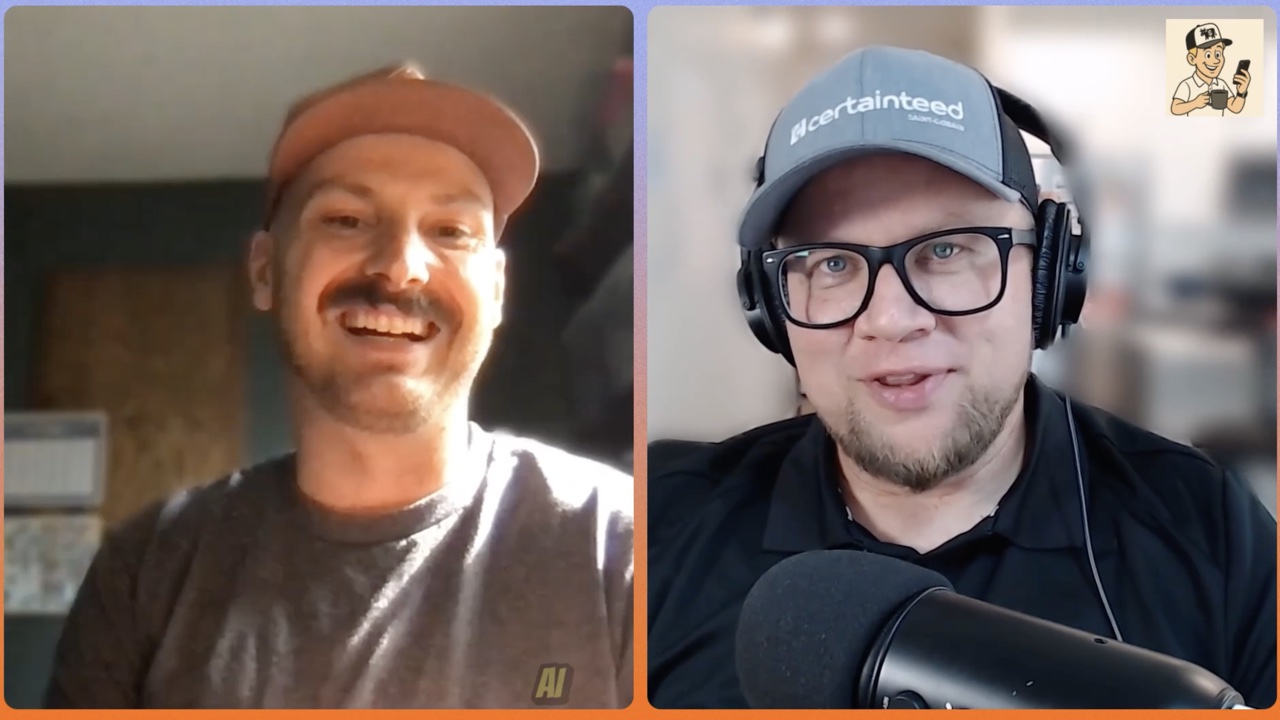
Denny Meints named his company Red Fox Remodeling on purpose. People already see contractors as a bit like a fox, a little sneaky, a little untrustworthy, so he put it right in the name as a standing reminder to his own team: lead with integrity, lead with transparency. Then he built the business model to match.
His path into the trades was a winding one. Tree houses and summer roofing as a kid, a double major at Bethel, five years of ministry work in Central America building alongside local block masons and craftsmen, then a sales job at a construction company that made him general manager within a couple of years. When a buddy from an investment group called out of the blue offering him a project manager job on three massive second-story additions, Denny countered: he had just gotten his GC license, so contract his brand-new company instead. That was 2022. In 2023 he went direct to homeowner, and Red Fox has been building a day at a time since.
The heart of this one is how Red Fox prices work. Design lives in-house, so by the time hammers swing everything is defined and the project runs clean. The contract is a guaranteed maximum price, not cost plus, so the homeowner knows the number on day one and the risk sits with the professional. And the bids are 100% transparent: every hour line-itemized, overhead visible, profit visible. The contracts get thicker and he loses some jobs over it. He signs them anyway, because "how much are you making on that?" never had a satisfying answer until the answer was: look.
Watch: YouTube Listen: Apple Podcasts · Spotify
Chapters
- 00:00 - Introduction to Denny and Red Fox Remodeling
- 01:05 - Denny's journey from college to construction
- 02:26 - Early experiences in Central America and lessons learned
- 03:48 - Starting in sales and transitioning to general contracting
- 05:16 - Securing large projects early in business
- 07:24 - Scaling to luxury home remodels
- 09:09 - The importance of in-house design
- 11:16 - Streamlining projects for better outcomes
- 13:17 - The value of transparency and risk transfer
- 15:16 - Handling unforeseen issues during projects
- 18:29 - Transparency in bids and pricing details
- 21:04 - The philosophy behind transparent profit and costs
- 23:25 - Complexity of large-scale remodels
- 24:30 - Challenges and realities of running a business
- 25:30 - Marketing, self-promotion, and social media
- 26:25 - The role of AI and technology in construction
- 28:51 - Advice to the next generation of tradespeople
The big takeaways
- Name the fear, then beat it. "The whole reason I named my company Red Fox Remodeling is because people already feel like contractors are a bit like a fox, a bit sneaky, a bit untrustworthy."
- Guaranteed maximum price transfers the risk to the professional. "Day one, you're gonna know how much this costs, and there's no ifs, ands or buts."
- 100% transparency doesn't change the price. "They see our overhead, they see the profit amount that we're trying to make, they see everything." The market sets the number either way; now the customer understands it.
- Show up with answers. When his crew found a corroded sewage stack behind a kitchen wall, they brought the homeowner on site, showed them the problem, and arrived with a plumber's bid in hand. That is how a change order builds trust instead of burning it.
- On the trades: "When you get in the trades, it's like you've now connected your brain to your hands and you're building something tangible."
Full Transcript
Lightly cleaned for readability. Speaker names corrected to the email-verified spelling (the auto-transcript heard "Mainz"); filler trimmed lightly, nothing of substance changed.
Reasonable Tech Dad (00:00) Welcome, ladies and gentlemen, to another episode of the Reasonable Contractor Podcast. I'm your host, Ryan Templin, the Reasonable Tech Dad, here with a new friend, Denny Meints. Is it Meints? Meints? Am I saying it correctly? Meints. Got it. All right. And Denny comes to us from Red Fox Remodeling. I took a look at the website, dude. The family videos. You guys must put a lot of work into those, dude. We love the family vibe on this show. Um, I mean, the the stuff we'll get into on your website. I guess we'll talk.
Denny Meints (00:11) Yeah, it's mines. Yeah, you got it.
Reasonable Tech Dad (00:29) More about that, but your website is outstanding, you got a good Google reviews, so I mean rather than me running down the list, why don't you just tell the people how you got started, man? What uh how'd you land where you're at? Tell us your story.
Denny Meints (00:40) Yeah, thanks for it. I appreciate it. Yeah. Glad to be here. Excited to chat a little bit more and uh thanks for the kind words about the website. I actually I get a lot of comments about the videos too, because they're they're a lot of fun. So it's it's really good. It helps people, I think, envision um space and just homes the way they wanna use it, which is great. That's the whole purpose behind 'em. Um, but how'd I get started um really
Reasonable Tech Dad (00:46) Definitely. They are. It's amazing dude.
Denny Meints (01:05) It's been kind of a weird journey for me to get into this industry. I love this industry, really love what I do. Um, I guess I'm a slow learner. I when I was growing up, I loved building tree houses, building forts, designing new things and building them. Um and then, you know, one of my buddies growing up, his dad was a builder in the area and so kind of saw that, was in and around that, did summers roofing houses, things like that. So
Reasonable Tech Dad (01:13) Ha ha ha ha.
Denny Meints (01:33) Always really enjoyed that and then, you know, went to college without really, you know, my parents really wanted to give me a four a four year degree and help me encourage me to do that, which is great. Um and so I went to Bethel University here in in Saint Paul and Yep, yep, Minnesota grown. So I went to Bethel. Um it was great. I met my wife there and um I got a
Reasonable Tech Dad (01:48) Minnesota grown.
Denny Meints (01:59) Bible and theology degree and a communications degree at the same time and really had no idea what I wanted to do with those degrees. Yeah, yeah. So double me. Sure. Well, maybe I I wasn't Yeah, I wasn't as studious as maybe I should have been, but uh we we made it work and um got out, did some did some uh Christian ministry work.
Reasonable Tech Dad (02:05) I bet, dude, but impressive at Bethel. Double major. That's a studious studious young man. And you and humble too.
Denny Meints (02:26) For about five years right out of college in Central America. And during that time I actually got a lot of hands on experience working with local builders and craftsmen in Central America that were doing a lot of block work, but like building houses and schools and really cool stuff that that just like, oh man, that it just kept every time I got involved in building projects, it was just like always really Yeah, it just kinda licked me up.
Reasonable Tech Dad (02:46) This is my thing. I bet that was so cool comp I mean it's gotta be completely different than doing trades here in the United States.
Denny Meints (02:53) So different, so different. I mean so many talented craftsmen in Central America that just like amaze you with the amount of work that they can get done and the pace and just like blew me away. And the the heat too is just like compared to Minnesota is like it could not keep I could not keep up. Um but it was fun to learn from them and just see and right down there it's just so community based too, right? It's just very everything is about
Reasonable Tech Dad (03:05) I bet. Yeah.
Denny Meints (03:19) community and and helping um uh people out and it's just a really cool culture and vibe, just uh just a warmer culture, just naturally. Um, but that's a whole nother conversation. But anyways, kinda when we decided to start a family and kind of kind of wanted to be more back closer to home in Minnesota again, we um I hopped around to a few kind of sales jobs, like was just kind of searching for things and then I actually found a sales job with a company
Reasonable Tech Dad (03:29) I bet, dude. Sure.
Denny Meints (03:48) uh construction company and I moved really quickly from sales to like operational support to being the general manager of that company uh within just a couple of years. And so um from there it was like it's a much larger firm than than what I have going on right now. But it just taught me a lot about the home the owners were amazing people. They've kind of showed me the behind the scenes of how how they ran the company, the numbers and all the things. They're super open handed with it. And then one
Reasonable Tech Dad (03:56) Sick dude. Wow.
Denny Meints (04:17) I just really felt the itch to start my own thing. I I just kinda let them know and I I kinda bumped myself back to a sales role while I went and got my GC's license and got things rolling. And so they were gracious enough to allow me to continue to do sales for them while I got Red Fox off the ground. And then the craziest thing happened is in that in that same time period, I had a buddy who is part of kind of an investment group in Minneapolis. Just out of the blue. Just didn't know. He we hadn't connected in a long time. He calls me out of the blue one morning and was like, Hey, um Denny, we're we have three projects in a dy now, like residential remodels, like massive remodels. We we were wondering about maybe hiring you for to be a project manager for our company and and I was like, Hey, actually can I counter offer you? I'm starting my own I got my general license, uh general contracting license, I'm starting my own design build remodel company called Red Fox Remodeling. Would you guys just contract me to do this for you? And they're like, that works way better for me or for them. It was Yeah, that was better for them. Um and you know that those three remodels there was a I was kind of coming in, they were they had a G C already that was had some struggles and I was coming in trying to help and bring him to the finish line. So a lot to talk
Reasonable Tech Dad (05:22) What a cool opportunity doing. It worked it was a better gig. That's more what they were looking for.
Denny Meints (05:43) the about there, but it was so cool to like start a start my business and then immediately have kind of three large projects to sink my teeth into.
Reasonable Tech Dad (05:51) Wow, what yeah, like you said, what an opportunity with a new business, dude. Like, hey, hello, like here's three sick remodeling jobs, let's get it going.
Denny Meints (05:55) Yeah, so that was cool. Totally. So, you know, I learned a lot through those jobs and like kinda cutting my teeth around those and then that was in twenty twenty two and then in twenty twenty three went direct to homeowner and started marketing my own business. Um, and the rest is kind of history. So just building it building it a day at a time.
Reasonable Tech Dad (06:19) Interesting good. So the last three years you say you know, that's the story, but like
Denny Meints (06:25) Yeah, right.
Reasonable Tech Dad (06:27) How did that transition like talk about that opportunity? So you got going and you had these three jobs. Did you have the subs lined up? You were a new company. Like as a project manager, subs are a a that's a big thing, dude. Like having good subs and like being able to understand how that scheduling goes and material delivery. So how were you positioned being a new company to handle three big projects like that? Where the was it new construction? Was uh you said it was a re three remodeling projects? Commercial, residential.
Denny Meints (06:35) Yeah. Totally. Yeah, three three really large they were all residential. They were all massive additions, second story additions. Um, I was definitely out of my depth. Like I could s I can say that with a straight face in front of you, like just jumping in, these are much larger than anything I was doing before. Um, you know, anything in my side quest. You know, I've owned several properties that I've flipped myself, doing a ton of the work myself. Different ball ball game when you get into, you know, these five thousand square foot
Reasonable Tech Dad (07:01) Okay.
Denny Meints (07:24) homes that they ended up being luxury homes. Um and it was a it was a tag team, right? Because there was already a GC on board working on them and he had his his crews. I brought in some people that I knew um and just kind of played tag back and forth to to kind of get them going in the right direction. So that's that's the long and short. And then it kind of really gave me some perspective for the size and scope of work that
Reasonable Tech Dad (07:25) That's huge.
Denny Meints (07:51) is out there and is possible and um really set me on a trajectory of really wanting to establish not just be a general contractor but to have more of a design build focus, having design in house and being able to serve customers all the way from concept, the initial concept of a p of a remodel, all the way through um kind of that final result, right? Just getting the space you're you're wanting. So
Reasonable Tech Dad (07:53) Absolutely. Yeah. That's another cool piece 'cause like anybody that hasn't looked at Denny's website, red fox remodeling dot com, you're you have a huge luxury flavor, right? Like that's and we talked about the family piece. That's amazing. Like, is that your family? The the grandmother and the kid? Like, or is that okay. Got it. Actors. Perfect. Okay. Which
Denny Meints (08:29) Sure. Yeah. Nope, nope, nope, none of those are my families. Those are all those are all actors.
Reasonable Tech Dad (08:42) I don't know how that decision's made, but either way, when you come to the site, the family feel is great, but I I think hearing you tell that story, it's so interesting that you had that unique opportunity where you had a contractor that kinda had some foundation. So you didn't have to carry the weight of three huge remodeling projects. You got to actually kinda come in and and be a piece of that rather than take on the whole load. And then you I I c I'm curious, 'cause I don't see a lot of that with the contractors I've talked to so far on the podcast, the in-house design.
Denny Meints (09:09) Mm-hmm.
Reasonable Tech Dad (09:09) 'Cause before I started doing project management, my dad owns a lumber yard and I was doing prints for five years and I got to see kind of what you're talking about when somebody comes in with a concept and helping them get it onto a set of prints before the construction even starts. That's that's I think what really gets people excited, right? And that's where people really like they get amped up and you know, and then budget conversations come in, they a they tamper down a little bit. What made you want to do the design in-house? Was it because of those early projects or was there something else that you saw
Denny Meints (09:31) Right.
Reasonable Tech Dad (09:37) in your previous experience that made you make that decision to have design in house? 'Cause that I in my experience that's not super common.
Denny Meints (09:44) Yeah, totally. It it was definitely it was a combination of those early projects and then even when I first went direct to homeowner in twenty twenty three, I didn't start with having design and all the projects we were doing back then were super uh uh homeowner led in the sense that everything relied on them getting me selections or things back like, Hey, yeah, you want you we want to do a tile bathroom then great, go look at tile and send me what you like and it was just kind of you know, it wasn't a great experience for a homeowner as far as like their
Reasonable Tech Dad (10:09) Exactly.
Denny Meints (10:14) There's just you know when it's overwhelming, right? There's so many choices to make, there's so many products out there.
Reasonable Tech Dad (10:20) Yes.
Denny Meints (10:21) You know, what's good, what's not good, is a five dollar tile, is that too cheap? Is it gonna break? Do I have to go with a you know, a twenty dollar per square foot tile? Like there's so much to navigate as a homeowner when you it's just so much more comfortable to have a dedicated professional that can walk you through things and advise you. And at the end of the day, the projects, um, I'm just thinking of our projects now versus back then, like Now our projects are so well informed and so well set up and everything is defined and there's no question marks. By the time we're s we're actually swinging hammers in your home, the thing just runs like a top. There's no questions, everything just rolls into the next thing and it's it's a beautiful thing. Whereas we those early years, those first two years w when I was transitioning from just strictly general GCing to being more design build. Um Man, it was just like a struggle every week to keep things on track and point
Reasonable Tech Dad (11:20) The fires and the material and the delivery and the scheduling, dude. When you talk about having a steam roll like a streamlined process, you're singing
Denny Meints (11:29) Yeah. Oh it's so much better. It makes me I sleep so well now.
Reasonable Tech Dad (11:30) That's amazing dude. Good for you, dude. S so I think that's a good transition. I think it's probably I think you probably already explained part of it, but like uh what makes you good when you come in and you're talking to people, why do they go with you? You know what I mean? Is that is that because of the design piece? Is it because you're so systemized? What what do you think makes you 'cause you're not the only guy bitten these nice jobs, especially these luxury jobs, right?
Denny Meints (11:37) Totally. Yeah, that's great. Yeah. That's so true. Yeah, that's so true. I think it is. Like design build is its it's its own thing, right? I always tell people like design build's not for everyone. It is gonna be more expensive generally speaking than just going and finding your own general contractor and then you just handle kind of all the design. But there's just uh there's gonna be some uh friction in that and I just tell them because I've experienced it right there's just a little there's some holes in that process and some friction that you're going to experience and our whole business model is to take all the friction out of that for people and just to make it smooth and seamless and easy and just know that you're going to have a straight line to the result that you're thinking wanting. And that's I think that's where the magic is really is like to to be able to have that HG TV type experience on the front end of designing because is really exciting, right? Like we're putting things into Chief Architect, you're gonna see the 3D walkthroughs and like even applying all the selections that they're making into those so they can really see it ahead of time. Yeah, visualize everything and then be able to go from that into just a really seamless transition into building where it's just like, Wow, this has all just been lined up and it's intentional and it's not it doesn't feel haphazard or like we're making it up on the fly. So
Reasonable Tech Dad (12:49) It is. It is exciting. Visualize it ahead of time.
Denny Meints (13:17) I think that's a big thing and then I'd pair it with sorry to be long winded here, Ryan, but I'd Yeah.
Reasonable Tech Dad (13:22) No, you should. People like this stuff, man. I think people really like those details and and lay it out, man. Don't be shy. Tell us.
Denny Meints (13:28) Yeah, I'd I'd pair it with the fact that we also I feel really strongly that like if I'm gonna hire a professional to come work on my home and and to be doing really high end luxury work, like I want to know ahead of time that like out the risk is transferred over to the professional, right? Like I'm I'm paying yeah, yeah, I'm I want to transfer that risk. And so we feel strongly about taking that on. So we do a guaranteed maximum price contract. So we're not doing cost plus
Reasonable Tech Dad (13:48) That's super well said. I saw that on your website. I'm glad you brought it up because I wanted to ask about that and we can get into my thoughts on the chaos of when you talk about systems. The reason I love hearing that and I make such a big reaction is because I've I've come up in an industry where people are like construction, that's just how it is. And I look at it, I'm like, I don't know if it has to be. You know what I mean? So um talk about that a little more, like double click on that.
Denny Meints (14:01) Yeah. Oh. Yeah. Totally, yeah. The guaranteed maximum price. It just goes back to that risk transfer, like cost plus. I just saw that and it's not like people doing that, like it's in an it's been inherited, it's been passed down in the industry for uh decades, decades. Maybe over a century. It's just like that Yep. Cost plus, like whatever the cost ends up being, plus our fees, right? Like Yeah, yeah, yeah.
Reasonable Tech Dad (14:32) Yes. It's like an expectation, that's just how it is. There's boats called change orders, you know. Come on Change orders, come on.
Denny Meints (14:46) So it's already like, you know, there's so much like there's people get sick, people well like things get lost in transit, like materials get like lost like whatever, like there's delays, like all all sorts of things that you cannot control for a timeline already, where it's like we can't fully guarantee your end date because acts of God, like well, all the things right that could happen because we're coordinating twenty different people or companies to come work in one location and they're all, you know, subconscious.
Reasonable Tech Dad (15:12) Yes.
Denny Meints (15:16) So because I can't guarantee that, I mean we get it really close and we can I can guarantee like a substantial completion, but not a complete completion. I want to be like, hey, you already have some uncertainty here with that going on, just inherently. I want to take the uncertainty of you wanna day one, you're gonna know how much this costs, and there's no ifs, ands or buts, and you can just go to bed at night knowing like, all right, we've agreed on a price, let's get to the end result we've agreed on.
Reasonable Tech Dad (15:44) Not hey, we open this wall and it's gonna be another five grand, you know what I mean? Like
Denny Meints (15:47) Well, yeah, and and there are things and and I'm not saying that there's aren't changes. There are definitely especially when we get into old homes where it's like you're n unless you want me unless you're gonna allow me to to demo your walls today and see what's behind there, there are things that yes, like we've like a great example was we did a kitchen, right above the kitchen was a a hallway bath, and when we opened up the walls to to um put in some new plumbing and to put in uh a vent pipe and all these things, we saw that their primary stack to their
Reasonable Tech Dad (15:51) Of course.
Denny Meints (16:17) Uh that was going up to that um bathroom completely corroded, just already starting to weep like sewage water. It's not what you want. And so it's not part of our scope of work, so it's not guaranteed, right? So we couldn't have guaranteed it. They didn't know about it, we didn't know about it. But what we do when we encounter something like that, Ryan, is we immediately kind of call the homeowners, get them involved, show them on site, hey, this is what we found when we opened your wall. Do you see this corrosion? Do you see that, you know.
Reasonable Tech Dad (16:26) No, gross.
Denny Meints (16:47) When you flush up there, it's it weeps a little bit of yeah, sewage water. Like you're building a beautiful new kitchen down here. We don't we don't want this is gonna completely fail in a couple years. You don't want that. Like we already have a bid from our plumber. This is how much it's gonna cost if we just wanna completely take care of this. You guys don't have to worry. Yep.
Reasonable Tech Dad (16:53) You don't want this in the walls down here. Absolutely not. Absolutely not. And you lay out those details right there on site when you have them and you show 'em. They it's not like, oh hey, you know, we found this, we're gonna get back to you kind of deal. Like that stream like that's part of your streamlined process of maybe why you can have that guaranteed part, because you have that system laid out so well.
Denny Meints (17:11) Yeah, no. Exactly. Yeah, we wanna we wanna show up with the answers, right? We don't wanna just show up and just talk about you know, we wanna have solutions. If we're gonna meet with our homeowner, we should already come floated with some of the solutions. Maybe we don't have all of them, 'cause maybe we need obviously some back and forth with a homeowner.
Reasonable Tech Dad (17:32) Yeah.
Denny Meints (17:33) to get to the final solution, but we should have just like, hey, it's our strong recommendation that you take care of this while we're doing this project. Um we have a bit for a plumber. They're ready to go on it if you want to just pull the trigger, here's how much it it's gonna be in a change order. Um so there are things like that that come up. When you get into the newer houses in the suburbs that are, you know, that first or second ring of the suburbs, it becomes less and less problematic. You run into less, but homes in St. Paul, in Minneapolis, these older stock of homes We do run into that situation where it's like no one could have known. It's not part of our scope of work that we're guaranteeing, and you should address it. So let's have the conversation. So uh that's that's a little bit about that. But I just feel like the guaranteed maximum price, I'm passionate about it. The other thing that we're doing now today to help owners is 100% transparency bids. And so they can see
Reasonable Tech Dad (18:07) Nobody.
Denny Meints (18:29) Every line item, uh, we're taking all the markups out of our bids. So um, but what that does is our our contracts get thicker because we have to account for every hour that anyone spends on their project is gets line itemized. And so they just they see everything. They see our overhead, they see the profit amount that we're trying to make, they see everything.
Reasonable Tech Dad (18:46) So they're seeing every detail, labor, everything. That's crazy. How did you come up with that idea? To me, that seems like madness. But I mean to me, I think there's two pieces without distracting from I want you to finish the answer to that. I don't want to detract from that because I think it's important. But I just think it's critical when you talk about change orders, how you're when you say you don't have answers, you're leading them. When you show up with answers rather than, hey, kinda maybe we found this, I don't know. I think that builds a massive amount of trust. And I think this transparency thing is even more along that concept of trust.
Denny Meints (18:57) Yeah. Yeah. Totally.
Reasonable Tech Dad (19:24) When you're telling people how much you're making on a job, because I see in a lot of project management where people come back and they're like, Well, you know, can I get that broken down material labor? You know, and they want to see that. And and, you know, from a contractor's s perspective is like, Hey, you're gonna take that and go shop it. You know what I mean? So when you made that decision to show that transparency, can you talk about how and why you did that a little bit?
Denny Meints (19:27) Yeah. Yeah, well I just feel like you know, the whole reason I name my company Red Fox Remodeling is because people already feel like contractors are a bit like a fox, a bit sneaky, a bit untrustworthy. And so it's kinda hugging the problem of just like it's a reminder to the
Reasonable Tech Dad (19:58) Yeah. I love that dude.
Denny Meints (20:04) uh our team of just like who do we want to be? We wanna lead with integrity, we wanna be lead with transparency. And you know, for these years we've been making all these really good changes with our process and design and all these things and I just kept being like, I just don't love that people don't understand our numbers. That people get so like, Well, how much you know, I understand that this is the line item for this fixture, but how much are you making on that? It's just like just never felt good. And it's like, yeah, there is a markup on that 'cause so you have to You know, w we Yeah, it's a business and we all for free and we you know, that's why I'm here to like that's how I'm able to be here servicing you today is is that markup. But be it's not a good s very satisfying answer to people. It's just like well why's your markup this and not this? So to go to a hundred percent transparency model is I think it just provides like there's no question and it doesn't change what I'm gonna charge you. I'm still gonna charge you like we still have to be able to pay all of my staff and we still need
Reasonable Tech Dad (20:35) It's a business. It's a business.
Denny Meints (21:04) need to cover our overhead and we still need to make a profit at the end of the day we're a we're a business. And so if you have an issue with paying us what what us uh you know what the industry yeah what we're asking and and frankly what what the industry
Reasonable Tech Dad (21:08) Yes, you do. What we're asking.
Denny Meints (21:22) can dictate. Yeah, the market the market's dictating this. It's not just we're just deciding to charge this. It's like you go go get other bits from other competitors. We're not being unreasonable with with what we're charging and you can actually see how where the where you know behind the curtain. This is exactly where the money goes.
Reasonable Tech Dad (21:23) dictates and the market dictates. I've never heard of that anywhere and I am just floored. And correct me if I'm wrong, maybe this comes from a little bit of maybe you're faith-based. I picked up on the website, and maybe some of the, you know, when you talk about integrity, we talk a lot about on this show is when people get into those conversations of, you know, bidding and estimating and some of the back and forth with customers about them trying to understand what you're making. Um at the end of the day, I think I've gotten some agreement from a lot of people on this. A business's purpose is to serve their community, right?
Denny Meints (21:49) Yeah, totally. Yeah. Yeah. Yeah.
Reasonable Tech Dad (22:09) And they cannot do that without revenue and profit. That's super simple. And we can the like people want these bus these services and these products, but they have to understand that the business has to make money. And the fact that you can lay that out openly and still be winning jobs, man, that's not only is it admirable, but like I'm impressed. Like I think it's amazing to.
Denny Meints (22:13) Yes. Hmm. Yeah, thanks, man. And we lose we lose some jobs because of it too. Um
Reasonable Tech Dad (22:35) That was that was gonna be a question. Do you think that, you know, you've probably lost some jobs with that? And I would my guess would be yeah.
Denny Meints (22:41) Yeah, we have and it's it's just the the situation of like you can see your cost of goods and services, you can see our cost of project execution and then you can see our overhead and our profit and just some people just don't can't really at the end of the day tie what it actually takes to execute a seamless remodel. Mass you know, we're doing, you know, these larger scale, you know, full full kitchens, full bathrooms, additions. You know, we're not just coming in and changing your countertops or or just doing your flooring, which is those are great services that need to be done. That's just not our business model. We're doing what I would say is we're gonna transform a whole space. We're gonna do a a whole space transformation. And so it's they are larger projects on the whole
Reasonable Tech Dad (23:10) Ha ha ha.
Denny Meints (23:24) and that amount of coordination, I think people Yeah, people under underestimate the complexity and what goes into making sure the details are right.
Reasonable Tech Dad (23:27) Complexity. The complexity is insane. So cool, Denny. What a what an amazing idea. I'm a little floored. Like I didn't know that existed. Um and I guess we c I could ask you, like typically I would go next to challenges, but I feel like you've already laid it out. You've talked about the the the challenges of, you know, coordinating the multiple pieces. Is there a
Denny Meints (23:38) That was that. Sure.
Reasonable Tech Dad (23:55) And maybe that's just because of your your heart and your soul and your optimism about life. I feel like you talk about it like everything's streamlined and everything's good and and business is good. Is there any part of Red Fox right now where you're like, man, this is this is tough, this sucks. Or is there is there anything like that in your business or is it is it that magical?
Denny Meints (24:09) I mean always. No, it's not. It's not that magical, right? There's it's a real business in the real world. Like we're still dealing with Yeah, yeah. It's like we're still dealing with people, right? On a daily basis, whether it's, you know, we we love our um
Reasonable Tech Dad (24:18) Sure. Just making sure.
Denny Meints (24:30) our homeowners, we love our subcontractors, but that doesn't mean people don't have bad days or there's difficulty or in communicating or things like that. So there's there's still friction that you you still have to w work with. But uh honestly the biggest thing that I've been I've been so resistant as an individual to um self promote and market and like be be out there like, you know, I I love hiring good people to do great work. And one of the things as a founder owner, like is that is can only be in my court right now is is promoting and not because I'm ashamed, it's just because it feels so um it feels self it's not, but it feels self-aggrandizing of like, oh we're so great and we're so this and uh like that. So social media, which for remodelers is like an like a baseline necessity has been something I've been super focusing on this year. It's like, all right, we gotta elevate our game because we do amazing work and people need to see it and people need to see how good my team is.
Reasonable Tech Dad (25:19) Yes, I would agree. Yes. Yes.
Denny Meints (25:30) And um the way that people do that is like social media first and if they like that they might go to the website. And if they like that, maybe they'll contact us. So it's it's getting better at that and being more intentional with opportunities, even just like this, Ryan, of being out there talking about what we do and what we do well. And um honestly it's just like a s a self mental block 'cause I am a relatively private person for the most part and market
Reasonable Tech Dad (25:40) Makes sense. Yes. gonna say, you come across as humble. And I could see that be contradictory to the the self promotion part.
Denny Meints (25:59) Yeah, well and market Yeah, so marketing always uh when I'm when I am, I guess, at this point the face of the business, it's like, all right, you gotta p you gotta put yourself out there because honestly it's not it's not about it's not just about me anymore. Like we got an awesome team, we serve awesome people, and we just wanna continue to to spread that. So
Reasonable Tech Dad (26:21) I love it, dude. So AI, have you how have you been dabbling with AI in the text? Social media? There's no way that you haven't at least considered it.
Denny Meints (26:25) Oh I mean, here's the thing, yeah, it's like do I I I do not use AI efficiently, we'll just say that. I mean I've leveraged leverage AI in the sense of like just asking like ChatGPT like just generic like questions to like help me brainstorm or to do a little like, Hey, can you give me some copy on this and then maybe I'll take it and edit it? But it's here and there and it's completely sporadic. There's no system around AI. yet, but I mean it's I think everyone in the industry can see, like it's coming, like it's unavoidable. And the early adopters will probably benefit more than people that jump on light. And I I just don't even know what that looks like and need to spend some more time thinking about it, but
Reasonable Tech Dad (26:58) Yes. Got it. Yeah, that's uh maybe not uh something for our conversation today, but I have started with my project management and I've kind of started talking to some other contractors about this idea of a second brain. And I think that that's a good structure that I think is popular right now. And I also I've I've been pretty heavy in the AI stuff for the last couple of years. I was doing it at my dad's lumber yard, I had built some estimating apps and um it's really been helpful with project management coming in that I had such a strong AI tool belt because it if if you could I think early on, I think probably six to twelve in the last si six to twelve months the models have really made turned a corner in their capability because you talk about how dynamic construction is. And a lot of the stuff I've built, you know, a year or two ago, you would bring it to people, contractors, and they'd be like, Well, this isn't gonna work because every job's different, you know, that kind of idea and this can't it can't but I think it's there. And I think it's there when you build harnesses around it and me and you can talk about that another day or another episode, we can talk about that another time. But I I uh I would highly recommend that uh exploring those ideas further. So um
Denny Meints (28:09) Yeah, that's that's interesting. I I would I would love to hear your thoughts or anyone's thoughts on on best uses case for cases for it 'cause yeah, it's it's an opportunity.
Reasonable Tech Dad (28:16) Definitely. It is, it is, and it's cool. I think it's it's it's raw and it's new and there's some there's some head bumping to go on and some some mistakes to be made, but I think that uh like you said, the early adopters are gonna benefit by h by working through those hard parts. Uh no and I wanna be respectful of your time here, Denny. Let's uh we always wanna wrap on this show with the next generation of the traits. And I like to ask guys to say, you know, talk to the next generation about why it's a good idea or not. on why to get into the trades and I think you bring interesting perspective because of your Bethel graduation and you grew up in that the whole building as a young man and building in Central America and then you went to college, double major, and then you still landed in the trades. So what do you think the next generation should think right now?
Denny Meints (28:51) Sure. Mm-hmm. That's right. Yeah, man, it's a great question. I always encourage people that are considering getting the trades, like do it. Like if worst case scenario you learn a bunch of skills and you learn s some stuff about yourself and if you if you end up, you know, saying it's not for you, then no harm, no foul. But I tend to s find that more people that try it love it. And I think it has a lot to do with, you know, so much work nowadays in speaking of AI and just the i internet and all these things is we're sitting at a computer or using our minds to type into and st structure something on the interweb somewhere. And when you get in the trades, it's like you've now connected your brain to your hands and you're building something tangible that not only you benefit from, but other people immediately get this benefit from that it's like there's nothing like it to just create something.
Reasonable Tech Dad (29:39) Yeah, exactly. Oh, building something tangible in front of you and and s being of service like that and seeing somebody and putting your hands on stuff. It's like completely different experience that, you know, I think that the next generation should, like you said, do it. Just do it. We need ya. We need we need that we need the people and it's a good opportunity, man. All right, Denny. That was that was a fantastic answer. And I think you really brought some cool new ideas to for people to consider. And thank you so much for your time, man.
Denny Meints (30:00) So rewarding. Mm-hmm. Yep. Just dive in. Totally. Yeah. That's great. Yeah, thanks Ryan. Appreciate the time. Uh cool. That sounds good. See ya.
Reasonable Tech Dad (30:23) Absolutely. You have a good rest of your night, man, and we'll talk more later. Cool.