
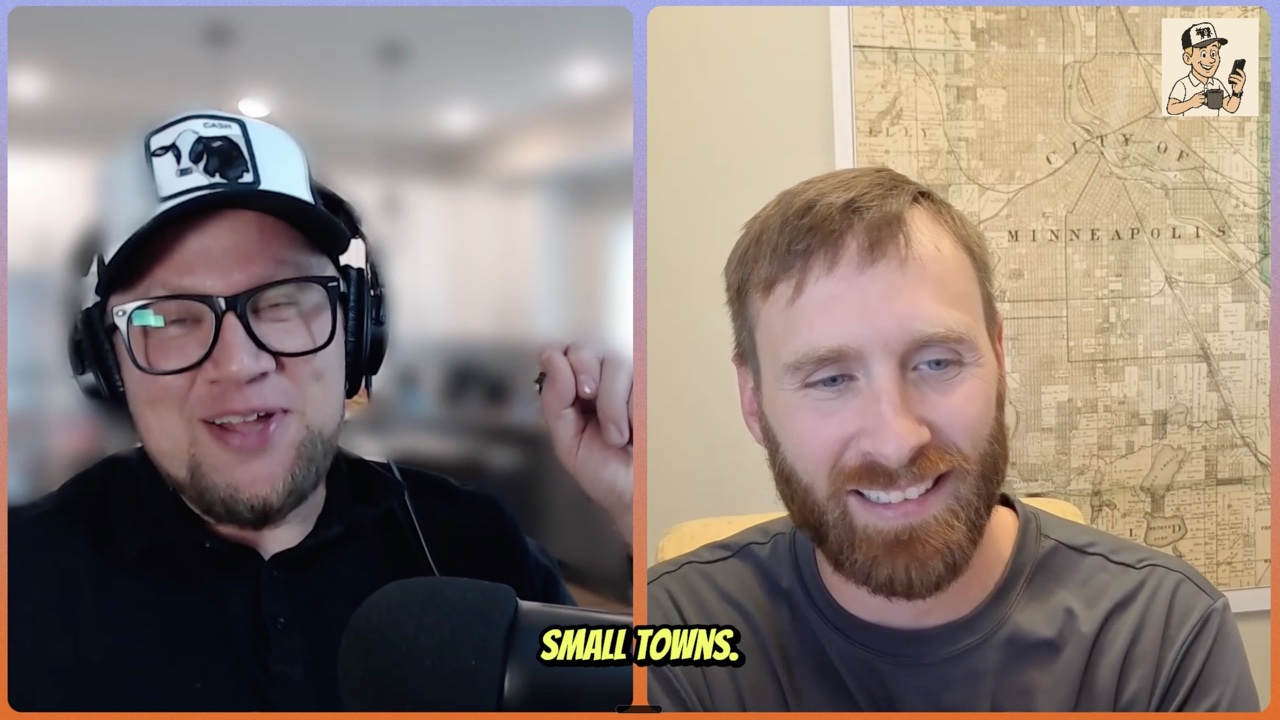
Andy Misiura started cleaning windows in high school as a way to make extra money. Eighteen years later, Kahuna Window Cleaning runs 45 full-time employees and does roughly 2.5 to 3 million a year out of one location in Minneapolis. The through-line he keeps coming back to is simple: he decided young that he was a window cleaner, this was his business, and he was going to become the best at it, instead of starting this and that and chasing the next thing.
The first half of this one is a masterclass in building slow and steady. Andy has grown revenue every single year since 2014, some years by a little and some by a lot, and he still says it feels like he's figuring it out. We get into the brutal Minnesota seasonality, doing 80 percent of the year's revenue in four months, and the real challenge of keeping a good crew together through the winter. We also get into the window cleaning boom, the flood of young guys coming in off TikTok, and the time he bought an entire company just to get its door knockers.
Then the back half turns into one of the best AI conversations we've had on the show, and it comes from a guy who says he's only been dabbling about a year. Andy talks about getting hooked when he switched from ChatGPT to Claude, the time he asked for a simple spreadsheet and got a whole working website instead, giving your AI a second brain so it actually knows your business, and using AI to research and prospect high-rise buildings. His read on AI and jobs is the same one I keep landing on: we are not going to run out of problems to solve.
Watch: YouTube Listen: Apple Podcasts · Spotify
Chapters
- 00:00 - Introduction and Andy's background
- 00:21 - From a high school side hustle to committing to the trade
- 01:14 - Growing Kahuna to 45 employees, one location
- 01:51 - The one biggest secret: pick one thing and become the best
- 03:34 - Humility, comparison, and not chasing the next thing
- 05:32 - Early to the web in 2007, and the TikTok window cleaning boom
- 07:38 - Buying a company just for its door knockers
- 09:16 - The water-fed pole boom and door-to-door saturation
- 11:46 - Seasonality: 80 percent of revenue in four months
- 12:44 - The off-season problem and keeping the crew year round
- 15:04 - Building a culture people are happy to show up to
- 17:08 - Getting into AI and the models turning a corner
- 18:28 - Switching from ChatGPT to Claude
- 19:02 - Asking AI for a spreadsheet and getting a whole website
- 24:17 - Give your AI a second brain
- 29:23 - AI for marketing, SEO, and high-rise prospecting with Fable 5
- 32:07 - AI and jobs: we won't run out of problems to solve
- 34:23 - Innovation, abundance, and the room to improve in the trades
The big takeaways
- Pick one thing and become the best at it. Andy's one biggest secret isn't a growth hack. He committed young to being a window cleaner and stuck with it for a long time, instead of chasing the next shiny thing. Consistency over decades is why he's still standing.
- Grow against yourself, not against the internet. He compares this year's revenue to last year's at the same date and pushes for incremental improvement, rather than getting rattled by how fast it looks like everyone else is winning online.
- Seasonality is a real business problem, not a footnote. Doing 80 percent of your revenue in four months means the hard question isn't the busy season, it's how you keep good people through the slow one.
- Build the company you'd actually want to own. Andy runs every decision through one filter: what's in it for the employee to be here. He only wants people around who are happy to show up.
- AI turned a corner, and the tools can do more than you'd guess. Andy asked Claude for a spreadsheet to track his Twins tickets and got a whole working website instead. Most owners ask for the small version because it's all they think is possible. The tool quietly does the bigger one.
- Give your AI a second brain. The model itself isn't where you store everything about you and your business. It needs somewhere to go back to for recurring context, and Andy's point is that it's cheap and easy to set up. You just have to ask.
- More productivity doesn't mean layoffs. If everyone can do more, we don't run out of work, we take on the work we couldn't touch before. It's just another tool on the belt.
Full Transcript
Lightly cleaned for readability. Overlapping fragments merged into full turns and speaker names tidied; nothing of substance changed. "Claude" restored where the auto-transcript heard "clod."
Reasonable Tech Dad (00:00) Welcome, ladies and gentlemen, to another episode of the Reasonable Contractor Podcast. I am your host, Ryan Templin. I've got a new friend with us today, Andy from Kahuna Window Cleaning. Andy has been in business for eighteen years, and better than me telling the story, I'll let you give your background. Andy, thanks for coming on, man. Tell the people your story.
Andy Misiura (00:21) Absolutely, thanks for having me, glad to be here. I started window cleaning when I was in high school, just as a way to make some extra money. By the time I graduated it had kind of blown up into something that was keeping me busy full time. I wasn't dead set on it, but around 2013 or 2014 I decided to commit. This is going to be my identity now. I guess I'm a window cleaner. Let's see what we can do about this. So I've been working pretty hard for the last several years, and we've grown to right around 45 full-time employees. We'll do about two and a half to three million dollars in window cleaning this year, from our one location here in Minneapolis.
Reasonable Tech Dad (01:25) Congratulations, sir. So you have multiple locations, other locations outside of Minneapolis?
Andy Misiura (01:30) No, just from our one location. That's our revenue, yep.
Reasonable Tech Dad (01:32) Got it. Those are crazy numbers. So that's an easy transition for me. What makes you good? How'd you get those kind of numbers, dude? Tell us how that went from one guy committing to his identity to 45 employees. That's got to be a cool story.
Andy Misiura (01:51) Yeah, lots of trial and error along the way. For whatever reason I've just felt like every single year I've got to grow a little bit more. I would constantly track last year's revenue at this time, and I absolutely had to be ahead every single year. There have been years where we just barely squeaked by with a little bit of growth, and some that have been larger. But if you look at the totality, it's taken a long time to get to where we're at. I look around and I see a lot of people that have done it much, much faster, that have figured some things out we haven't figured out yet. But I think the one biggest secret is I committed when I was very young. Okay, this is who I'm going to be. I'm a window cleaner. This is going to be my business and I'm just going to become the best at this, rather than start this and that. Just sticking with one thing for a long period of time is probably why we're here today.
Reasonable Tech Dad (03:10) That's so cool. So you actually hit that growth number every year. There wasn't the yo-yo. It was either just a little bit of growth or it was more growth, since 2014. That's really impressive. When you say you looked at other guys and think they grew faster, is that still a mystery to you, or have you identified some of those things?
Andy Misiura (03:34) I still feel like I don't really know what I'm doing. It still feels like I'm figuring some things out. You look at how everyone portrays themselves online and you go, man, that happened really quick for them, or their business is a lot more profitable than mine. You get that impression looking around. But you try to remember too, I'm not out there sharing my hardships with everybody either. A lot of people probably look at our marketing or our vans around town and maybe they wish they had what we had. So just comparing your business to your business last year and going for those incremental improvements, I think that's the answer. You don't want to chase the next thing. I see a lot of people in my industry do that, because it's a very easy industry to get into. A teenager like myself back in the day could get into business with a quick stop at the hardware store. When I started in 2007, I was one of the only window cleaning companies with a website, and I was figuring out how to clean windows in old forums, the old forum format, using keywords to find answers to things. Now these guys are scrolling TikTok seeing "do you want to make a thousand dollars a day cleaning windows."
Reasonable Tech Dad (05:39) Come on.
Andy Misiura (05:45) Exactly. So you've got a lot of young guys coming into the industry, which is actually kind of cool, I'm excited about it. But I've also seen a lot of people come in really hard, build something really quick, and then they were on to the next thing when it got hard, or maybe when they got bored. Window cleaning right now is experiencing a huge wave of new business owners. Everybody has a neighbor that has a son that cleans windows.
Reasonable Tech Dad (06:44) Interesting dynamic. Do you think that's local to this region, or is that by and large an internet trend? Is it the cheapness of access, like you talked about, where any kid can go to the hardware store with a thousand bucks and get going?
Andy Misiura (06:58) I think it's very much an internet trend. I don't consume a lot of industry stuff on YouTube, but I recently hopped on to better understand what's going on in the market. There are some pretty big window cleaner influencers. I'm like, this is a crazy niche, and then I look at their following and they have hundreds of thousands of followers, just teaching people how to start and grow window cleaning businesses. We just purchased a company that was grown on the back of this influx, and what they did to get all their customers was door to door. So we purchased that business and the door knockers came along with it. The whole purpose of buying the company was to better understand the door-to-door channel. We spend a lot of money on marketing and we're kind of at the mercy of when people want to call us, but if we could send people out to a certain zip code and get business on demand, that's something I want to figure out. And every neighborhood we're hitting right now, they're telling us, man, you are the fourth, fifth guy out here this month.
Reasonable Tech Dad (08:39) What?
Andy Misiura (08:40) It is absolutely saturated. And we're trying to be really smart about it, going into areas we're heavily saturated in. That's what we're seeing, and it's a lot of young people starting window cleaning businesses.
Reasonable Tech Dad (09:01) This summer in Minnesota, knocking doors and hearing you're the fourth or fifth guy that came to the house this season, that's insane. I would have never guessed that. Ever.
Andy Misiura (09:16) And more data points. I have a good friend that works at a window cleaning supply company, so they're the ones selling the equipment. There's a water-fed pole system, they're about three thousand dollars, and you can clean the windows from the ground. So a lot of these guys aren't even getting ladders. They're throwing their water-fed system in the back of a sedan and going door to door. The amount of water-fed pole systems they've sold this year and the end of last year has been absolutely insane. It's a boom.
Reasonable Tech Dad (10:01) My guess is that would be lower in quality than climbing up there. Correct me if I'm wrong.
Andy Misiura (10:11) Generally for the first clean, absolutely it's lower quality, yeah.
Reasonable Tech Dad (10:15) Okay. And are they that much cheaper for the customer?
Andy Misiura (10:24) Some of the guys, it depends on the company and the time of year. If they're knocking doors in April they're getting a ton of business. They're knocking doors right now, and anyone that's purchased window cleaning has already done it, so they're trying to catch people at the perfect time, and they're probably going to be lowering their prices. So if anyone listening wants to get their windows cleaned really cheap, there's probably some teenager in your neighborhood willing to do it for a very good deal.
Reasonable Tech Dad (10:59) Now's the time.
Andy Misiura (11:02) But yeah, I imagine they're probably a little bit cheaper.
Reasonable Tech Dad (11:11) Just so I can keep digging to understand the window business a little more, since you're talking about seasonality. I'm learning on the construction side just how crazy this time of year is, everybody has to get their stuff done. In Minnesota you only have a certain amount of time to get your siding done every year. How is it in windows? How long is the season, and how do you adjust for it?
Andy Misiura (11:46) This is something we track pretty closely. We do about 80 percent of our revenue, actually it's like 81 and a half percent, in four months.
Reasonable Tech Dad (12:05) Wow. It makes sense. On the construction side, guys can right now already be talking about scheduling into the fall and winter, trying to line up which jobs can be done when it gets cold. With windows that's not an option. You probably have to have it all locked by a certain point, and then the rest of the year, is it a shutdown? Do you keep everybody on? What do you do in your off season?
Andy Misiura (12:44) That has been a question we've tried to answer many different ways for many years. Up until this upcoming year, my own personal philosophy has been I'm going to work as hard as I can, and my team is going to work as hard as they can, to make as much money while the customer wants to buy. And then we're just going to take off in the wintertime. As a single guy, and newly married, I'd try to get out of the country, go somewhere warmer for extended stays, maybe two to three weeks at a time. That was a lot of fun, like the summer vacation you'd look forward to in school. But that has gotten more and more expensive over the years, because you burn through so much cash. You have to have so much cash sitting in the bank at the end of the year, and we budget for that, and over the winter you watch it dwindle all the way down. You're starting the season going, boy, I hope the snow melts because we've got to get some money in the bank pretty quick.
Reasonable Tech Dad (14:09) I bet it's anxiety-driving as a business owner. You start getting wound up about it.
Andy Misiura (14:11) It's a real challenge, and it's just gotten more and more expensive. Not only that, but we've got employees that have been here a number of years, their families are growing, they're trying to buy a house, get married, have kids, and going on unemployment is a hardship for them. While they really like us and like working for us, eventually we're going to lose them if we can't give them something consistent year round. So we're looking for other things to do, and we think we've stumbled upon some good ideas.
Reasonable Tech Dad (15:04) I really love that, man, because a lot of business owners can relate to how important it is to build a culture and have people around who are loyal and care, versus a constant hire-fire cycle. How valuable it is to not have that turnover. And almost more importantly, on a spiritual level, the connection. It's interesting to hear you bring up families, and what comes with the financial expectations of a job and a career where you've been a long time and have loyalty. Those things start to generate tension, and the fact that you consider that speaks to your quality not just as a business owner but as a man. Good for you.
Andy Misiura (15:56) Absolutely. It feels way better having a place where people show up and are just happy to be there. Even purely selfishly, that's the company I would want to own. I only want to work with people that are happy to be here. So we look at every decision from that perspective, what's in it for the employee to be here.
Reasonable Tech Dad (16:29) That's a really nice framework. It's got to be a big part of the reason you've done well over the years, because taking care of people pays its dividends, especially over time. I feel like you've kind of addressed the challenges already, the seasonality, the marketing and saturation, the next wave with the internet, and employee retention. So that's probably three of your biggest things. You didn't go into detail on marketing though. Have you started implementing any AI technology? Or have you stuck to your tried-and-true methods? Where are you at on the new tech wave, since you were dabbling on YouTube? There's no way you didn't hear about AI when you dabbled on YouTube.
Andy Misiura (17:13) I could go on forever about what we're doing with AI, and I'm so excited.
Reasonable Tech Dad (17:25) Come on and hit me, I'm a tech guy, man. I love it. I've been hard on it for three years. In construction in particular, when I first got into it three years ago, I already had a bit of a coding background. I started out at my dad's lumberyard, and I was trying to build an application that would do lumber estimation, top to bottom, when the original 3.5 ChatGPT came out. To put it concisely, a lot of the tools, and you'll see this in the trades, guys say AI can't do it because every job's different, the dynamic inputs that come with construction. I'm sure windows has the same issue, window sizes are crazy. But what's happened over time is, in the last year, maybe even less, six months, the models have really turned a corner. And there are a lot of harnesses around the models that have really built up the capability to handle a lot of that dynamic input. Have you seen the same thing in your tinkering?
Andy Misiura (18:28) Well, I've only been dabbling for about a year, and yes, I've absolutely noticed a difference. Even when I switched to Claude from ChatGPT, my goodness. And I stumbled upon it purely by accident. I got sucked in. Man, that's addicting.
Reasonable Tech Dad (18:52) Yes, it is. Talk about it, dude. Go nuts. We talk about this a lot on this channel, because I'm an AI nut. I could go crazy.
Andy Misiura (19:02) Okay. So we have Twins tickets. Not huge Twins fans, I wish I was more of one, but we have tickets we'll give to customers or employees. And I'm like, I need a way to track who's going to what game. That was it. Hey Claude, here are the tickets we have, season tickets, this number of games at these times, and I need a way to track this. I thought it was going to spit out a spreadsheet, but it spit out a whole website where people could... this is what I didn't understand about the capability, and this is really what opened my eyes. There was a miscommunication, and it developed a whole website where you can open up this URL, see all the games, click and sort them by month. If you're looking at July, you can see who they're playing against, the time, whatever special promotion they've got, if it's dollar beers or something.
Reasonable Tech Dad (20:18) Hot dog day, hot dog Tuesdays.
Andy Misiura (20:22) It's all in there. And I'm like, where did it get this information? This is the crazy part. You select what seats you want, you hit a button to confirm, it has you put your email in, so I know what email to send the tickets to. Then it's like, okay, confirmed, click this button to add it to your Google Calendar. I'm like, how did it figure this out? There was some work I had to do on the back side, but it showed me what it could look like, and I'm like, yeah, let's absolutely do this. Is this insane? So now I can just share that. If anyone wants Twins tickets, customers or employees, we share it, they fill it out, and I get a ping notification that they want the tickets versus the Blue Jays on the seventeenth or whatever.
Reasonable Tech Dad (21:19) No writing anything down, no typing numbers on your keyboard for the dates, no spreadsheet tracking. And my guess is if you took it a couple steps farther, you could even have it built into your side of things where you could just ask.
Andy Misiura (21:34) Yes, totally.
Reasonable Tech Dad (21:37) Gosh, that's such a good story, Andy, because it catches the piece I've been working on for years in construction. The fight against it, and then what's super critical about what you said. Because we're all programmed for twenty years that Excel is the way, or Word is the way, that there's a certain tool for a certain task, we could never articulate our inclination toward the tools we've used for so long. But how fast that box gets shattered when you start trying to do anything with AI, because of the capabilities it's brought. It's mind-boggling. I don't even know if I want to call it creativity. It's almost a pattern of recognition, based on what you're trying to do, of what the best tool is for the job, and the information needed to go with it, like you said, pulling in the Twins schedule.
Andy Misiura (22:38) Yeah, it is kind of like having a superpower. And obviously enough has been said about where all of this shakes out and where we'll be in five to ten years. But there is absolutely a wave to be caught right now in every single industry. Unless you're a coder, I don't know what those guys are doing, it's got to be tough for software engineers in the next few years. But for the rest of us, if you're the first window cleaning company to really buy in, wholly buy in and adapt, there are definitely going to be some advantages. Those are going to be short-lived because this is moving so fast. It's kind of like when I was a teenager and we were the first people with a website, but that was over the course of several years. When I started, people were buying spots in the phone book, and that's how they were getting all their customers.
Reasonable Tech Dad (23:51) I was selling phone book stuff. You talked about door to door, I was selling phone books still around 2005, 2006, walking into businesses with a button-up shirt selling paper ads in small towns. It was crazy, a mix of old and new. I think you're right that that window is still going to be there, there are still going to be people using Excel sheets, but it's going to close faster.
Andy Misiura (24:15) Mm-hmm.
Reasonable Tech Dad (24:17) So you used it that one time to build a website. Have you done things like second brains? Have you collected the business, do you have things that tie all the tools and connectors together?
Andy Misiura (24:27) I've actually been using a second brain way prior to AI, and I've kept that in Notion. When I connected Notion to Claude, that's when I'm like, my goodness, this is going to be incredible. Because I'd been using a second brain for a while, that part came very natural to me. Pretty soon I'm tracking every single wine I've had and every single bourbon. I can tell you what I've had, what I tasted, what my palate is, for every area of my life. I do a lot of different things, I just bought a smoker this year, so I'm slowly learning that, and I'm probably killing a whole bunch of rainforest figuring out recipes.
Reasonable Tech Dad (25:27) I don't know about that argument. I've dug into that data a little. It's not what the media says.
Andy Misiura (25:33) But yes, I use it probably way more than I should.
Reasonable Tech Dad (25:37) We're kindred spirits in what we track and how we think about things. I also had a second brain in Notion, and one in ClickUp before all the AI stuff. So as the second brain concept came to AI, and being able to tie into it and ask it questions, the structure, if built correctly, matters, because it can get hairy. You can get to the point where you're pulling in too much context, and you need to build the structure so you're only pulling the context based on what you're trying to get answers for. That's one of the biggest unlocks. You see it in the trades when people say, well, I tried ChatGPT and it can kind of estimate. Well, if you keep an eighteen-page chat going, context pollution and everything, start a new chat, people. Start a new chat with a new idea. If you're doing a new task, start a new chat. But even using the chatbots, and Claude projects are a good step in that direction, building your own second brain is a level that a lot of people should hear about. When built correctly, the difference is night and day in what the AI is capable of doing for your business.
Andy Misiura (27:16) Would your audience know what you're talking about when you say second brain?
Reasonable Tech Dad (27:25) Some. I think some, but very few. So any ideas you have, it's best if you share them, rather than just me, because those guys hear me talk about it all the time. I try to help people set up second brains, that's something I do.
Andy Misiura (27:37) Yeah. Just having a data set somewhere besides Claude and the Claude memory for it to reference back to. Claude is not where you want to store all the things about you or your business. Some things, so it has recurring context about you, but it needs a second brain to go back to. Okay, Andy, who is a father of two, is an entrepreneur, is making something on the Weber Searwood tonight, let me go into the area of that brain that stores that information. And Claude is very good at doing that. It's fairly easy to set up too. You could probably just ask Claude. Every time I've had a question, I've just asked how I should set it up and it tells me, or it does it for me. In your brain you're going to have areas of different context. If you're trying to work out a recipe, or figure out what wine pairs with a cut of meat, it goes to that part of the brain. Or if you're trying to do a complicated high-rise residential window cleaning quote, it goes to that part of the brain. It works so much better with the second brain, and it's cheap and easy to set up.
Reasonable Tech Dad (29:23) It is. Have you tied it to other things? We can wrap up soon, I know we're running long, but have you tied it to marketing and the business side? I'm really curious about marketing, since I can tell you're a detail guy and a data guy. Have you tried giving it full access to your ad spend or anything like that?
Andy Misiura (29:44) I have not given it full access, but I've let it poke around in there and said, hey, what could we be doing better. I've given it access to our website, hey, what are some things we could do to improve SEO. That's been crazy awesome to see work.
Reasonable Tech Dad (30:03) Yes, the website piece, I think it's really good at.
Andy Misiura (30:06) Yep. We do high-rise window cleaning as well, and those are larger tickets, slower burn, you follow up every year, find out when the contract renews. What I've found is Fable 5 is very, very good at researching who the contact people are for various buildings. So we can pull up a lot of data and start calling them. Because I don't think there are any other window cleaning companies doing this, they're kind of like, yeah, actually, we need to get three quotes every single year, please add us to your list.
Reasonable Tech Dad (30:51) We've been waiting for someone to call. We've been waiting for you to call. Thanks, Fable.
Andy Misiura (30:58) It's very easy. We have a sort of plug-in that has the context, and we pull it up and say, all right, give me fifteen, I'm going to call through them. We reply back to Claude with what the remarks or different things were, and it will draft emails for us and send those off to follow up. Or it will say, hey, it's been a week since you reached out to this one, give them a call too. So it's doing the work of an admin for an estimator. We can literally pull an estimator off the street and say, hey, you don't have many estimates to do today, why don't you call through this list, and if you have any questions, ask the bot, it should know what to do. It was just something I set up for a couple hours. I know it could be so much better if I spent some real time on it, but it's so fast at figuring things out. That's how we're using it for marketing. I know we could probably be doing a lot better.
Reasonable Tech Dad (32:07) I think you just touched on something. So many people are scared of what's going to happen, and there are some things to consider for sure. My ultimate optimism is that there are a lot of smart people thinking the same thing, and you've got to trust humanity at the end of the day, that's my chosen optimism. There are enough good people out there looking out for us. In the meantime, what's exciting to me is, without going into the data, more software coders were hired this year. Two years ago, when I came in and right away used it for coding, I'm like, this is dead. That's the post you see on social media, rip whatever career, rip marketers, rip coders. And what you just said is the thing that doesn't get talked about enough. Every person that picks up AI and gets good at it, they're like, cool, I did enough marketing today because I got what my old list did. That's not how capitalism works. If we increase productivity in any aspect, the question I always ask is, do you think they're going to fire people if each person can do more? We're not going to run out of problems to solve. I don't think that.
Andy Misiura (33:33) Yeah, that's the thing. If you run out of problems, that's a problem. But I don't think that's going to happen.
Reasonable Tech Dad (33:42) I agree. If we run out of problems, that'll be a whole new thing we'll open up. I always think when people open it up and start using it, they say, man, this got all my stuff done that I used to do, now I don't want to do anything anymore. No. You did it, and you're like, we called these high-rise guys and got these estimates done, got this website piece, got these new things we didn't even know anything about. I think it gives people excitement to do more. It's just another tool on the belt. That's what I love about it, and I think more people should jump in. Andy, any more thoughts to add? I don't want to cut you short, you've brought some serious brilliance to it, and I really appreciate it.
Andy Misiura (34:23) Yeah, absolutely, thank you. I'd be more than happy to do this again, a part two or a deep dive. The one thing I'll add is, you think the thing that's going to hurt an industry is a big influx of new people or new energy or new ideas. You think it's going to hurt the industry, but it really doesn't. It actually gets more customers for your thing where there weren't any. It's like my buddy who does IT. Claude can solve a lot of IT problems, but the fact of the matter is it also creates a whole bunch more, so he's extremely busy in an industry you'd think is going out of business soon. It's removing problems and creating opportunity in other places.
Reasonable Tech Dad (35:26) Innovation is never a bad thing in our society, in business, by and large. There may be some edge cases I'm not considering, but innovation is a good thing, that's what companies drive for. That's what everybody competes for at the highest level. Everybody can use the tools that are out there, but who can innovate? And what happens if everybody can innovate? How good can we get? I bet we can get really good. In construction, maybe not so much on the window side, but anybody who's had their bathroom remodeled recently can probably say there's a lot we could be doing better. Contractors in general, there's so much room for improvement. We shouldn't worry about overdoing our productivity. Let's put one foot in front of the other here.
Andy Misiura (36:25) Absolutely.
Reasonable Tech Dad (36:25) Andy, this has been awesome. I'd love to have you on for a deep dive, and we could dive into more topics. I love the way you think and the way you communicate, dude. Thank you so much.
Andy Misiura (36:36) Awesome, thanks, Ryan, appreciate you having me.
Reasonable Tech Dad (36:39) All right, dude, take it easy.